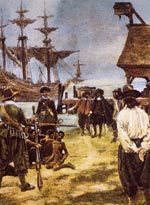
 | Ralph Lane 1530-1603 |
Ralph Lane was born in Lympstone, Devon, England. HIs mother was cousin to Catherine Parr, Henry VIII's last wife. Lane began his career in the service under Queen Elizabeth I. His duties in the Royal House included law enforcement and collection of customs duties. He quickly became a favorite of Queen Elizabeth and is noted for being a good soldier, fort maker, and leader.
These qualities are what lead to Lane accompanying Sir Richard Grenville on his voyage to the New World. The voyage departed from England on April 9th, 1685. Lane was commissioned to build a fort on Roanoke Island. After two months at sea, the voyage reached its destination in June, 1685. Lane and his men immediately began looking for a suitable place to build a fort. During these explorations, the men encountered natives. While visiting with the natives, a silver cup of Sir Grenville's disappeared. Grenville believed that the natives had stolen his cup and demanded Lane and his men to burn the native's village and their plants. This act marked the beginning of a hostile relationship between the natives and Lane.
The soldiers quickly ran out of supplies and because they were not settlers, they were unskilled at farming and fishing. Friendly indians, who were still on good terms with Lane, helped the soldiers by providing them with food. Grenville, in a hurry to return to England, left Roanoke Island at the end of August, 1685. He promised to return shortly with supplies. Lane was left in charge of 108 men. They worked hard to complete the fort because they knew they would need shelter in the winter.
Relationships with the friendly Native Americans quickly began to deteriorate because of Lane's and his soldiers' increasing demands for food. They also were spreading smallpox and measles among the natives, causing them to become even more unpopular.
Lane became convinced that it was only a matter of time before the indians attacked him and his men. So, he planned an attack on their village, where he murdered the chief, Wingina. Never again would the English have a good relationship with the Roanoke Indians. Shortly after the attack, the men noticed the ships of Sir Francis Drake's on the horizon. The haste to leave the colony was so great that Lane accidentally left three of his men behind. Once Lane returned to England, he never stepped foot on American soil again.
