July 22nd, 1587 John White and 117 colonists arrive at Roanoke Island
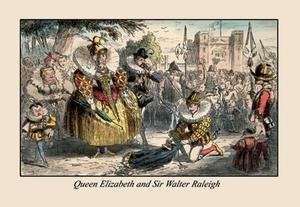
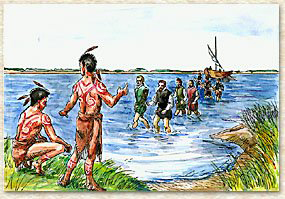
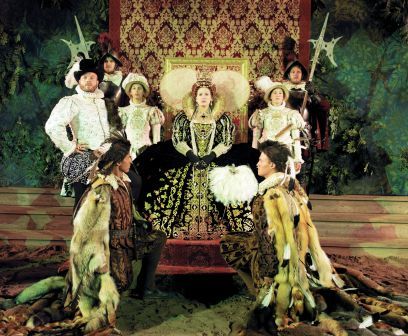
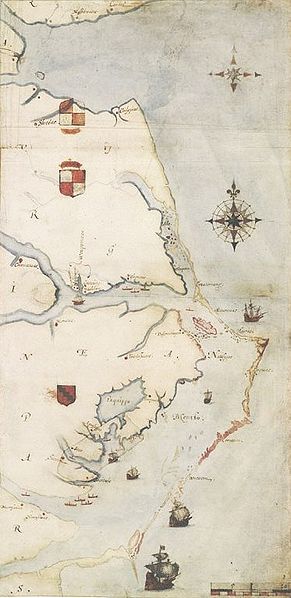
Philip Amadas and Arthur Barlowe led the first voyage. Raleigh only organized the voyages, he never actually stepped foot on American soil. Amada's and Barlowe's expedition left England on two ships on April 27th, 1584. It took the crew three months before they spotted land. On July 4th, 1584, the ships discovered the Outer Banks of North Carolina. This was an exploratory mission, as they had been instructed to find a suitable location for England to establish its North American Colony. The men surveyed the terrain and traded with local Indians. The Englishmen and the Algonquian Indians became so well acquainted that when the explorers left for England they brought with them two powerful Indian chiefs, named Wanchese and Manteo. Amada's and Barlowes's favorable reports of America led to the idea of placing a permanent English colony on Roanoke Island. Queen Elizabeth was delighted by the successful voyage and the Indian chiefs. She knighted Walter Raleigh as a reward for this success.
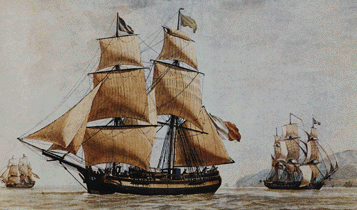
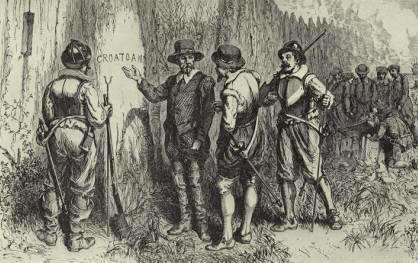
The second voyage was led by Sir Richard Grenville, Sir Walter Raleigh's forty-three year old cousin. The voyage left England on April 9th, 1585. Grenville commanded a fleet of seven ships and more than 500 soldiers, sailors, and skilled workers. Also on board was John White, a skilled artist, who was to record images of whatever interesting things he saw. Wanchese and Manteo were to return home and serve as interpreters for the English. The purpose of this mission was to establish a military colony on Roanoke Island. Ralph Lane was placed in charge of the soldiers and the colony. The fleet reached their destination on June 24th, 1585 and immediately began constructing a fort and houses shortly after their arrival. In August, Grenville and his fleet returned to England, leaving Ralph Lane and his soldiers to survive in the new world. Relations with the native tribes quickly deteriorated and resulted in several attacks on Indian tribes lead by Lane. In June of 1586, Sir Francis Drake, arrived at Roanoke Island and transported Lane and his men back to England. Raleigh was upset with Lane and his dealings with the Indian tribes, he feared that his attempts to colonize America had been lost. However, due in part to White's favorable paintings and tobacco, interest in an American colony was still peaked. Raleigh and White began planning another expedition. 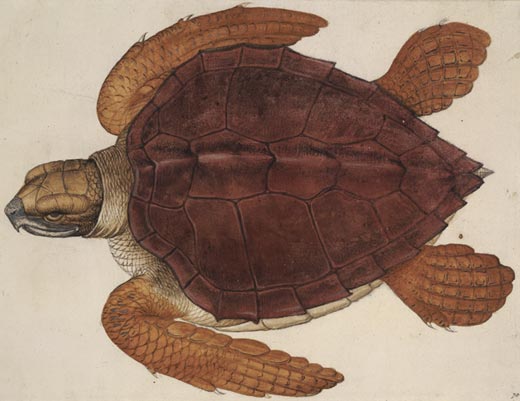 On May 8th, 1587, John White and his legendary 117 colonists set sail for Roanoke Island. Many in this group were families. John White's expecting daughter Eleanor, and her husband were on board. Manteo was also on board, this time he was to serve as a guide. On August 18th, just a month after the settlers arrived in Roanoke, Elanor gave birth to a daughter, Virginia Dare. Virginia was the first English child born in North America. Unfortunately, the settlers had arrived in Roanoke too late in the year to plant crops. Unsure what to do, the settlers agreed that White must return to England and retrieve additional supplies. Due to the war between England and Spain, he did not return to Roanoke Island for three years. When he finally arrived, he found the colony deserted. The only clue left behind was the word "Croatoan" carved on a tree. The vanished settlement became known as the "Lost Colony." |
||||||
 |
 Visit The History Channel to watch a video and learn more about Raleigh and the Roanoke Colony. |
|||||